Depression
We all heard about it. Some touched by it. Some heard it from a friend or a family member. Some on TV. But we are all familiar with it.
Recently I have been touched by it. Not because I got a depression but because someone close to me got one. And it was really bad.
I did take action immediately and avoided what could have ended in tragedy.
But I couldn’t shake the thought “What if I hadn’t been there?”
I wasn’t around and only came to check on something else. And thanks God I did.
Thinking
This whole situation got me thinking. I studied Psychology and I have a degree on the subject. But never paid much attention to clinical depression because:
- (1) I knew I would never exercise as a Psychologist, and
- (2) Didn’t find it relevant.
It is my personal belief, if your mind is strong, no matter what life throws at you…you dust up and continue fighting.
But this whole situation got me thinking. A lot. And not just on the fact of how close depression touched me this time. But also on the components of it and what lies the core of the “illness”.
And I decided I will find a solution.
“Need is the mother of invention”
And this is a very needy situation - if you ask me.
But on the positive side - I think I have figured it out.
Depression seen through a different frame
“Depression is the lack of hope. If you have hope you can’t be depressed.”
If you spend some time with someone with depression, the ever lasting feeling is of dread. There is no joy for life. But more importantly there is no hope.
So we know depression is the lack of hope.
It’s the lack of a path forward.
But from the outside it doesn’t look like it.
It is as if the person was trying to navigate while walking in the darkness with a veil on her eyes. So the little amount of light that could tell her where to go was obviously missed.
But if you are by her side, you can absolutely see some of that light and guide that person towards it. And help her find the way.
So the second component of a resolution for depression is
“You need someone to guide you”.
We know now, if we help someone navigate the depression and back into hope now you can be on the path to resolution. We still have to deal with re-lapses but once you know how to do this it is a whole different story both for you and the other person. There can still be episodes but the duration and depth can be shortened out. Even more so with conditioning, at the core of things we are still animals and the same mechanisms that work on Paulov’s dogs do work on us.
Anyway, getting back to the resolution - we have the 2 core things we need here.
Now we need the path. And pay attention, continuing with the same analogy, I said: someone to guide the person, not to lift her up and bring her into the right room. This is very important because that person needs to regain hope and you can’t give it to her.
So how do we do this?
The Method
I devised a method which works out of an analogy too. It’s called the window. And if we continue with the same analogy…if you were to open a window on that veil where she could look through - she would see by herself where to go.
Isn’t that right?
And so we will make that window.
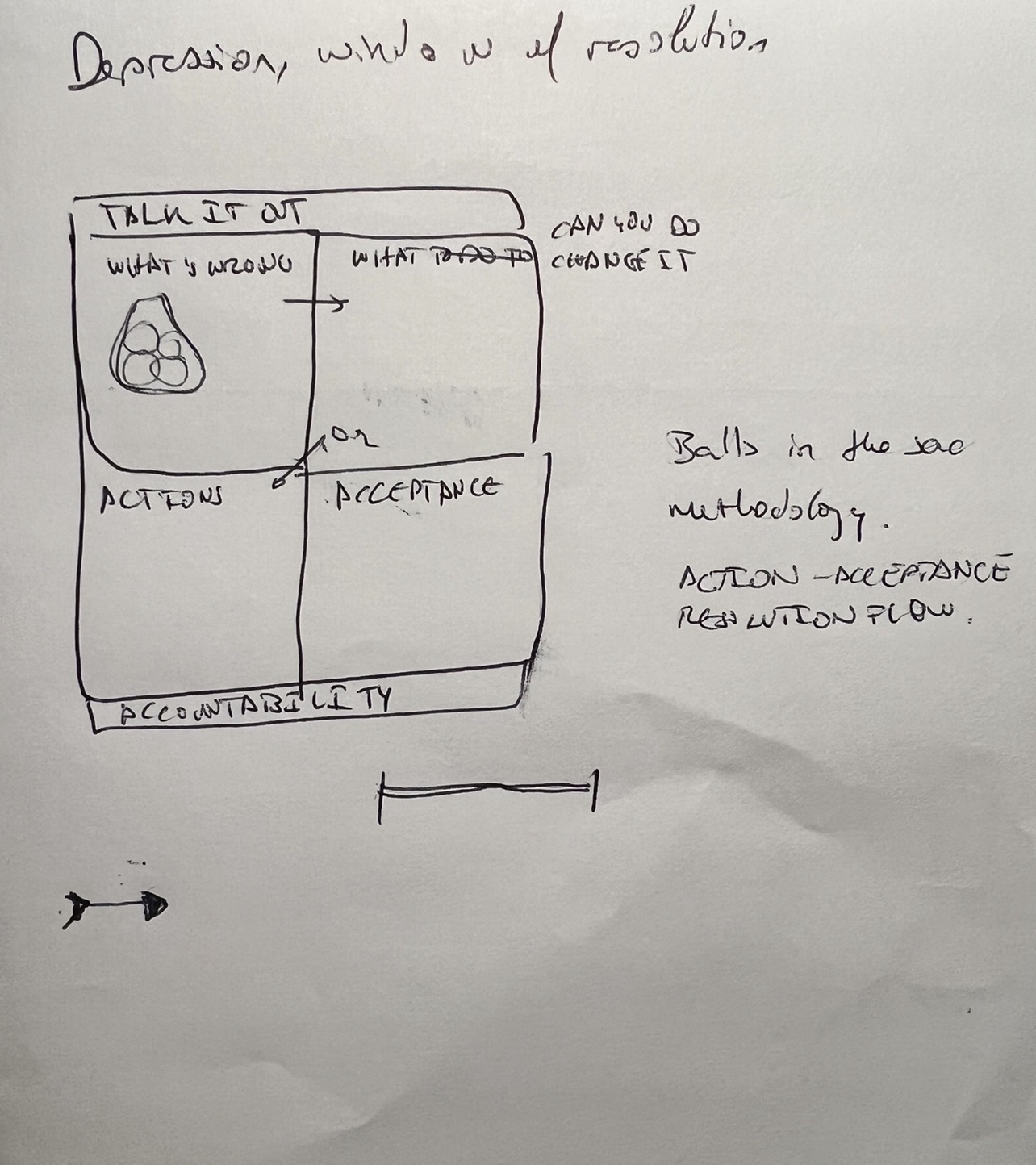
Here is my first draft of how the window method looks like
So the window of resolution has one analogy people with depression will understand straight away: “too many balls in your sack” or “too many balls in your bag”.
That is someone who keeps piling up bad thing into a bag, each being a ball on their own.
And those balls are heavy.
They weight the person down. And once it is too heavy you fall into dispair. Which is the opposite of hope.
And dispair creates the veil, the illusion that all is going wrong.
So the first things we have to do is to let her talk it out.
This is the top foundation of the window. The person needs to be honest, sincere, and ready to put it all out.
Because if not, there is no one that can help. And this is why people go to psychologists.
So she will talk it all out. And it is as simple as asking “What is really wrong?”. Careful to not say “What is wrong” that will elicit an automatic response, so if you start with this, ask then after that “What is really wrong?”. Also, beware to not say “What is really wrong with you?” because that is accusing she of making it up.
Of all the things she will say write them out. In order. This constitutes the first panel of the window.
The order is also important because they can either be from most recent (top of mind) to less recent or normally from more important to less important. Ask her to tell you which ones are more important after anyway. Usually the top ones stay at the top with some rearranging on the bottom ones as recall is usually non-linear.
Now we have something to work on so we move on to the second panel on the window. For each of those balls ask her “What can yhou do to change it?”. If she doesn’t know, help. Many times something is really difficult from the inside but when someone from the outside (an outsider) looks at it, it can have a very simple solution.
Do that as many times as needed. And follow through each thing if it has multiple steps. These should either reduce the size of those balls or make them disappear altogether.
But not everything has a solution. Sometimes people carry balls related to people who have died. And that is a different story altogether.
Once you are done with the second panel you have the ammunition to complete shape of the window with the last 2 panels: actions and acceptance.
For each of the items that have a resolution, ask her to write the actions to take on each on the 3rd panel.
And for each of the items that don’t, write those in the acceptance side, which is the 4th panel.
The 4th panel is not a complete loss, because once you see all of the things laid out you can still do things. But the important bit on those is what the name entail.
Actions are the action of guiding her to the light, acceptance is the act of letting her stay in the light. Now the bag is not that heavy…so she can move. And she has a path to the destination.
For anything that went into acceptance, there are strategies for these things because a lot of the things you can’t change are only a problem of frame. E.g.
“If you wanted to say something to someone that has died”
- (1) likely that person knew.
- (2) if she is religious - “you can tell him on the thereafter”, or “he is watching you now, so he knows.” etc.
To complete this method and the window in itself we need to anchor it to the wall and for that wee need the last part, the bottom piece: accountability.
And here is where you and everyone involved help her stay accountable in doing the actions (or helping her do the actions). And staying consistent on what has been accepted so those balls don’t grow again. Especially for things that she can’t change.
Next steps
This is a method that works, and is being trialed at the minute. Restoring hope is the final goal. Keeping that person hopeful the holy grail. The window method is a tool to find the path to hope - so use it accordingly.
Wherever possible get professional help.
I hope this can help you as much as it has helped me.
And if you know someone who could benefit from this. Please share it with him or her. Let’s battle this together because a lot of people never get to help and the most dire things happen when someone is in dispair and doesn’t get help.
Updates
So far this new paradigm is having a lot of positive feedback. And what is more I have got some good ideas out of that feedback. One such is the idea of tiny positive things can turn negatives into positives.
It is known a drop of water can turn tainted water into clear water. It is known a small thing can ripple effect - and produce waves (of any sort) that have a transformative effect.
The problem with depression is the focus on the negative things, guided by the overall theme of hopelessness which turns thoughts into a negative loop which spirals down creating negative entropy in the thinking process and therefore the experience of that person.
The idea here is this small seeds, positive things, positive experiences could turn hopelessness, and negatives into positives via the same mechanism.
The best part is those tiny positives don’t need to be new.
They just need to be guided towards it.
Isaac AR.